
First try at rice farming

This year, we’ve decided to try rice farming for the first time.
Partly to improve the land and soil, but also as a way to become more involved in and gain hands-on experience of the full cycle of food production here in Tamba Sasayama. Crop rotation is an essential part of the long-term plan to prevent soil depletion, and alternating between edamame beans and rice helps naturally restore nutrients to the soil without relying on chemicals.
Learning from the Community
We’re very much beginners, and we’re fortunate to be surrounded by experienced local farmers who have been very generous with their time and advice. Rice farming here is built on traditional knowledge that has been passed down through generations, and it quickly becomes clear how much technique and timing matter.
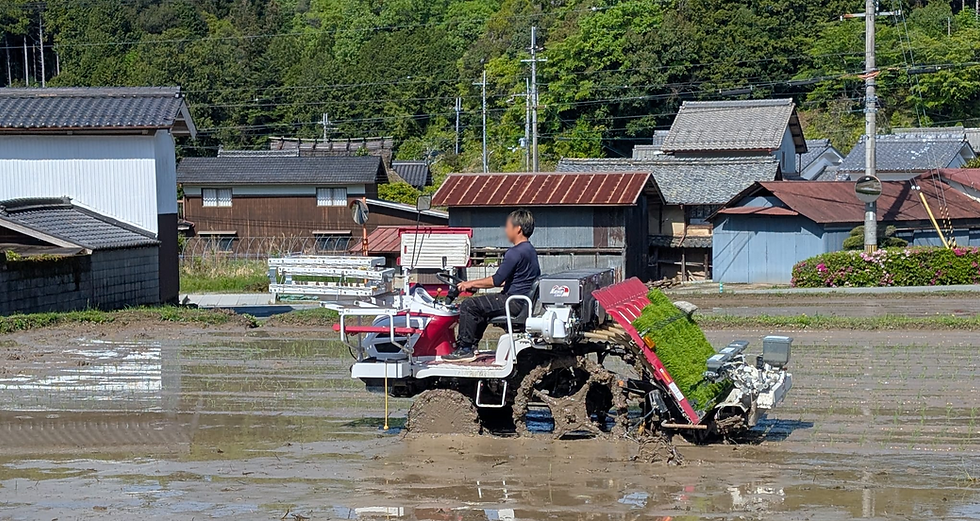
Nowadays, rice farming is rarely done entirely by hand at any scale. It relies heavily on specialised machinery, so we are working with a local farmer who will handle the tractor work, planting, and later in the season, the harvesting. That support allows us to take part without needing to invest heavily in equipment at the outset.
Preparing the Field
Before any planting could happen, we had to get the field ready.
One of the key tasks was preparing the banks (あぜ, aze) which form the edges of the rice paddy and hold the water in place. Because this land hasn’t been used as a rice field (田んぼ, tanbo) for many years, the edges needed quite a bit of attention.
We also discovered a number of mole holes running through the banks. Even small gaps can cause slow leaks that drain a field over time, so we used corrugated plastic sheeting (あぜ波シート aze nami shīto) - to reinforce and plug those weak points.

Water: The Lifeblood of the Field

Rice farming depends on proper water management.
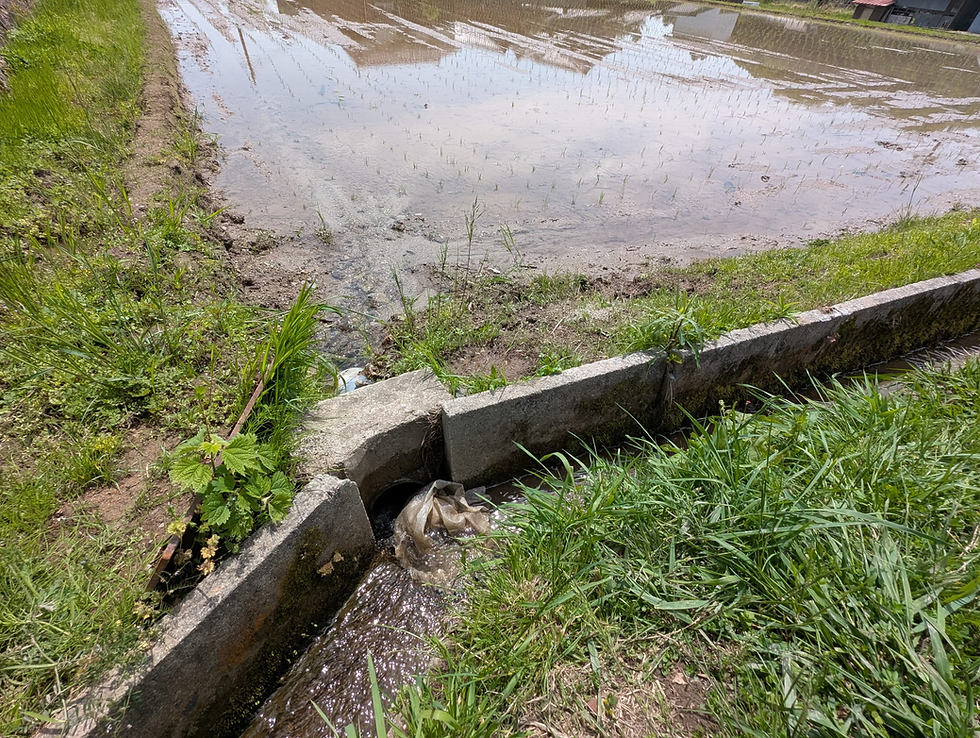
Our field is supplied from a reservoir at the top of the village, with water flowing down through a network of channels. Having access to that system is both useful and a privilege, but it also means working in coordination with others. When to take water, how much to use, and how to keep it flowing all need to be managed carefully with people upstream and downstream.
Even small changes in one field can affect everyone else connected to the system, especially in the summer when water becomes an even more valuable resource.
A Small Season for Beans
Alongside the rice experiment, we will also be growing beans again this year but on a much smaller scale. We’ll plant just a small number around our vegetable patch rather than doing a full crop.
That means there won’t be much available to buy online this season, but if you’re nearby during edamame season, please come and check in with us and see what we have available.
This year is very much about learning, understanding the land, the water, and the rhythm of rice farming. We’re expecting mistakes, adjustments, and hopefully a harvest at the end of it all.
If nothing else, we’ll come away with a much deeper appreciation for every bowl of rice.

Comments